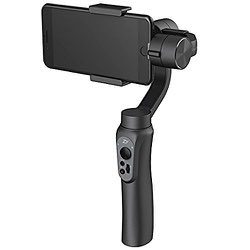
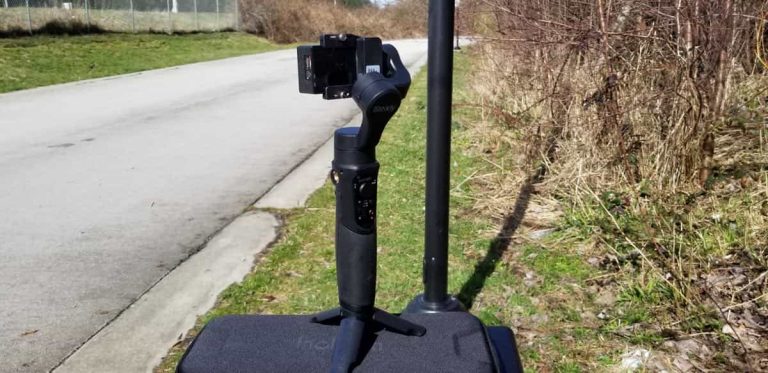
Water-Resistant Action Camera Gimbals: Reviews and Guide
Affiliate disclosure: As an Amazon Associate I earn from qualifying purchases. Product links marked as paid may generate a commission at no extra cost to you.
Key distinction: A waterproof GoPro camera does not make the gimbal attached to it waterproof. This guide compares splash-resistant action-camera gimbals using documented manufacturer limits, explains why IPX4 is not an immersion rating, and helps you decide when a separate motorized gimbal is worth the extra complexity. It replaces an older product-ranking article that used the word “waterproof” too broadly.
The short answer: which models can handle water?
| Equipment | Documented manufacturer wording | Practical interpretation |
|---|---|---|
| Hohem iSteady Pro 4 | IPX4 splash-proof | Protection against splashes; no underwater/immersion claim |
| FeiyuTech G6 Max | Splash-proof | Designed for some splashes; manufacturer does not supply an immersion rating in the reviewed specifications |
| Other older action-camera gimbals | Varies by model and generation | Do not infer a rating from marketing photos or the camera mounted on it |
| Waterproof action camera alone | Check the exact camera’s rating and limits | Camera sealing is independent of gimbal sealing |
The Hohem iSteady Pro 4 product specifications explicitly state IPX4. Our IPX4 versus IP67 guide explains the important difference between splash resistance and immersion testing. FeiyuTech’s G6 Max specification sheet uses the term splash-proof. Neither is a basis for claiming an IP67 or underwater gimbal. Always follow the exact model’s manual for temperature, ports and environmental limits.
What IPX4, IP67 and a missing rating mean
An IP code refers to a test-based level of protection. The first character after IP relates to solids; “X” means there is no published solids rating in that position. The second character denotes a water test. IPX4 describes splash-water resistance, whereas IP67 includes a specified solids rating and a temporary immersion test under controlled conditions. These are not interchangeable; a device with IPX4 should never be described as IP67.
“Waterproof,” “water-resistant” and “splash-proof” appear inconsistently in older retailer descriptions. When a gimbal maker does not publish a reliable IP code or an explicit testing claim, treat its environmental resistance as unverified. An aftermarket protective case for the camera does not seal the gimbal’s charging port or motors.
Hohem iSteady Pro 4: action-camera-focused, but only splash-resistant
The iSteady Pro 4 is built for small action cameras rather than a heavy interchangeable-lens camera. Hohem lists a gimbal weight of 365 g, a maximum camera payload of 160 g, and a camera height limit of 51 mm with a thickness limit of 30 mm excluding the lens. Its battery capacity is 3,600 mAh and the advertised maximum operating time is 14 hours under laboratory conditions. It also lists supported GoPro models and selected DJI and Insta360 cameras, but Bluetooth camera control is more limited than physical camera fit.
An advantage is its purpose-built action-camera layout, relatively compact size and specified IPX4 rating. Limitations include camera-specific wireless controls, a constrained maximum payload and no immersion protection. If your recording conditions include repeated wet exposure, the risk to powered equipment may outweigh the benefit of controlled pans.
FeiyuTech G6 Max: more flexible payload, still not for immersion
FeiyuTech publishes a 1.2 kg payload and a 665 g gimbal weight for the G6 Max, with up to 9 hours of battery endurance under its referenced test configuration. It supports some compact, mirrorless and action-camera combinations, subject to manufacturer compatibility details and lens clearance. For creators using multiple camera types, that flexibility is the reason to consider it over a specialized action-camera-only unit.
FeiyuTech describes the G6 Max as splash-proof. It does not provide a supported underwater claim in the specification page reviewed. It is also a bulkier solution than a small action-camera support, so check whether your camera’s electronic stabilization already achieves the desired result before carrying an extra powered device.
Legacy water-oriented gimbals: Feiyu WG2 and REMOVU S1
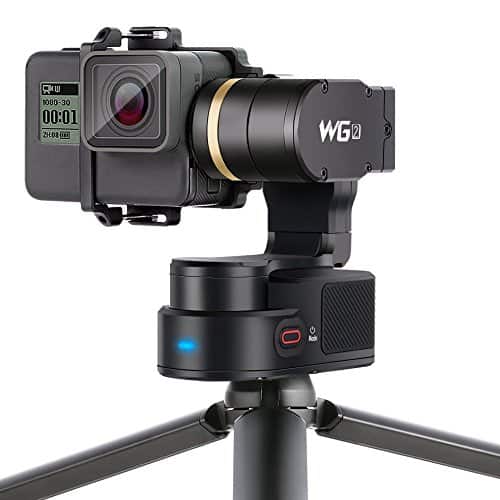
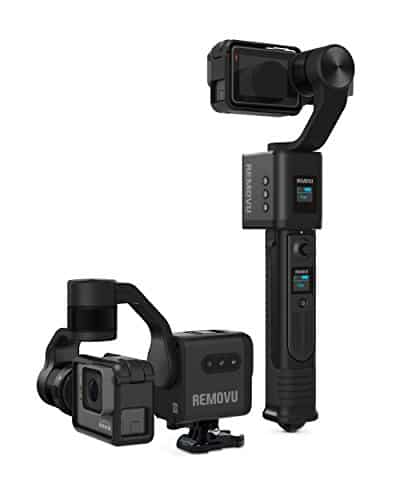
Several older GoGimbals comparisons featured the Feiyu WG2 wearable gimbal and REMOVU S1. Their archived photographs are included below so owners can identify the equipment, but the units are not presented as currently supported underwater products. Product generations, sealing, batteries and accessories are easy to confuse. If shopping second-hand, look up the original model-specific manual, inspect condition and confirm replacement parts or original chargers are obtainable.
Does an action camera need a gimbal at all?
Many action cameras have electronic image stabilization that may already be adequate for everyday scenes. Motorized supports can improve control of camera rotation and repeatable framing, but they introduce an additional battery and potentially vulnerable connectors. For ordinary travel, a simpler setup can be more practical and easier to protect than attaching a complex gimbal. A stabilization accessory is most useful when you have a specific movement or composition in mind, rather than as an automatic upgrade.
How to evaluate compatibility before buying
- Camera body: check manufacturer-supported width, height, thickness and payload; do not assume a model generation is identical to its predecessor.
- Camera controls: mounting compatibility does not guarantee start/stop, app or Bluetooth compatibility.
- Protection: verify the gimbal’s own published water rating rather than the action camera’s sealing.
- Availability: check firmware, manuals, original mounting parts, battery condition and retailer returns for older devices.
- Operating time: quoted runtimes often reflect controlled balancing and may be shorter with moving motors or camera charging.
- Real need: compare the value of a gimbal with composition, sound and the camera’s existing electronic stabilization.
Common mistakes in waterproof-gimbal shopping
Assuming the GoPro’s waterproof rating covers the entire rig
It does not. Every electrical component, including the gimbal, has its own limits. Accessories can also change how ports and seals are exposed.
Confusing splash-proof marketing with underwater certification
IPX4 is not the same as IP67. A manufacturer’s “splash-proof” description should not be upgraded into an immersion claim without evidence.
Purchasing an old gimbal based on launch-era specifications
Even a well-designed older model may have aged batteries, unavailable support or incompatibility with newer camera shells. Assess the actual unit and current manufacturer’s information.
Ignoring camera stabilization
Before adding motors, evaluate whether the action camera’s internal stabilization makes separate hardware unnecessary for your planned type of footage.
A practical decision framework
For dry conditions with a compatible GoPro and a need for pan or tilt control, the iSteady Pro 4 is worth checking against the exact camera model. For a compatible mixed compact/mirrorless kit, the G6 Max offers a larger published payload but adds size. If actual immersion is expected, do not select either based on splash-proof descriptions; choose equipment expressly rated by its maker for the intended environment instead. For camera-only work, prioritize the camera’s own documented water rating and stabilization capabilities.
For related background, read our action-camera gimbal comparison, Hohem generations guide and how three-axis gimbals work. These links explain technology and model differences, not an endorsement of underwater powered accessories.
Archived affiliate retailer listings
Some listings retained from the original comparison include Amazon affiliate tags. They are provided only as historical references; their product availability, price and descriptions are not verified. GoGimbals may receive an affiliate commission from qualifying purchases.
- Original action-camera gimbal retailer reference 1 — verify the model and environmental rating independently.
- Original action-camera gimbal retailer reference 2 — verify the model and environmental rating independently.
- Original action-camera gimbal retailer reference 3 — verify the model and environmental rating independently.
Sources and verification
Specifications were checked against the manufacturer pages for Hohem iSteady Pro 4 and FeiyuTech G6 Max. This is specification-led editorial research, not an immersion test or firsthand review. Actual product support and conditions can change; consult the current manufacturer guidance before making a purchasing decision.