Gimbal Payload Explained: Why a 2 kg Rating Does Not Guarantee Fit
Does a 2 kg camera gimbal support every camera setup weighing 1.9 kg? No. A gimbal’s published tested payload is an important specification, but it does not establish universal physical compatibility. A long lens, accessories or an unfavorable center of gravity can change whether the exact camera can balance and move within the available axis clearances. This guide explains which measurements matter, how to interpret official manufacturer compatibility lists and why bigger payload numbers alone do not identify the right stabilizer.
This article focuses on the technical question of payload versus physical fit. For broad buying recommendations see our DSLR stabilizer guide and mirrorless gimbal comparison. Those established pages remain the appropriate hubs for category-level purchasing advice.
Tested payload is not a universal camera compatibility guarantee
A manufacturer may specify a tested payload after evaluating a particular gimbal using its own standardized setup. The figure describes load capacity under the maker’s conditions; it does not guarantee the complete range of camera body shapes, long lenses, lenses with moving barrels, microphones or camera cages. A camera with a modest total mass can still create clearance problems, while an officially recommended combination can provide stronger practical evidence than a headline weight.
For example, DJI lists a 0.4–2 kg tested payload for the RS 4 Mini and a 3 kg tested payload for the RS 5. Its official Ronin model comparison also provides recommended camera-and-lens combinations. The recommendations explain why buyers should look for their specific equipment rather than relying only on the maximum figure.
What to include in the complete camera setup
| Part of the rig | What to verify | Why the number alone is insufficient |
|---|---|---|
| Camera body and fitted battery | Full operating mass and physical dimensions | Camera screen and grip shape affect clearance |
| Lens and filter | Exact focal length, length and weight | A front-heavy lens shifts the center of gravity |
| Quick-release plate and approved adapter | Manufacturer-compatible mount | The available adjustment range may differ |
| Camera cage and small accessories | Approved dimensions and mounting layout | Extra hardware can extend into an axis path |
| Microphone, monitor or other approved equipment | Total mass, position and cable routing | Placement affects balance and practical range |
| Focus-control accessories | Specific motor and lens support | Additional parts and software may require separate approval |
The safest purchase approach is to compare the actual camera and lens you intend to record with against the maker’s recommended combination list. That list may still have notes about electronic control, supported firmware and attachment options. Additional unlisted gear should not be assumed to be fully compatible.
Why center of gravity changes the answer
Two setups can have the same total mass but distribute that mass very differently. A compact lens centered close to the camera may be easier to balance than a long front-heavy zoom. Physical reach also matters: as an axis rotates, the camera or lens must not strike nearby parts of the support. A gimbal’s camera-weight limit cannot tell you whether those clearances are available.
A related issue is an interchangeable lens whose length changes as it zooms. A setup that fits in one configuration might shift its balance in another. This is a reason to consider the actual shooting lens, rather than evaluate camera support with the body only. The manufacturer compatibility database is an important source of evidence for specific combinations.
DJI RS 4 Mini: what the published 2 kg figure means
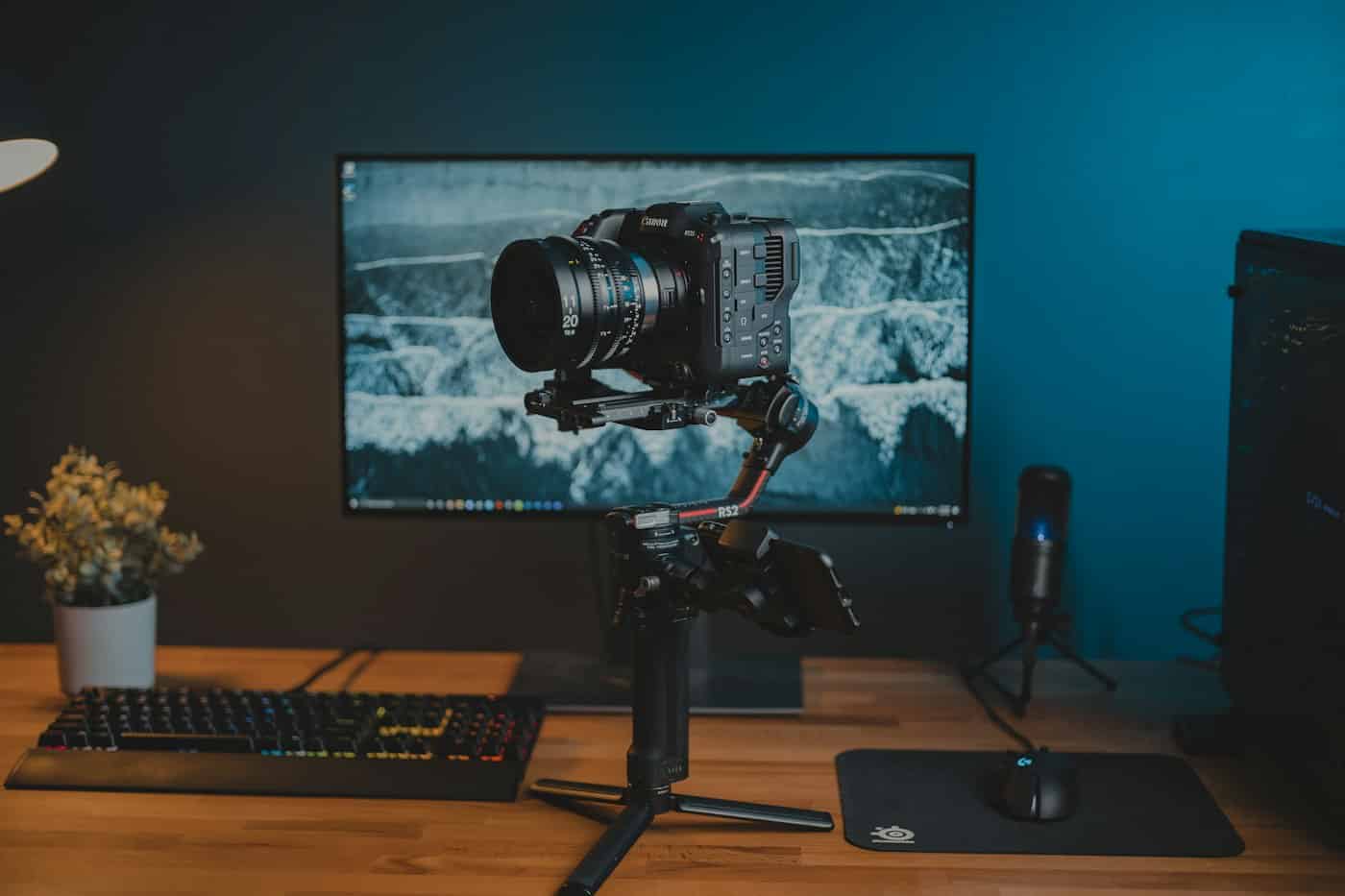
DJI specifies 0.4–2 kg for the RS 4 Mini. The gimbal itself weighs approximately 890 g including its specified quick-release plate, excluding the separate mini tripod. Its official product data also identifies supported axis movements, automatic locks, camera control and certain tracking accessories. None of those features removes the need to check a specific lens and body combination.
The Ronin comparison names examples for RS 4 Mini such as a Sony A6400 with E 16–50 mm F3.5–5.6 and Canon EOS R7 with RF 15–30 mm F4.5–6.3. These are manufacturer-provided reference combinations, not our field tests. DJI’s list should be revisited when choosing another lens, cage or recording configuration. Reference: DJI RS 4 Mini specifications and the camera comparison chart.
DJI RS 5: a larger payload does not remove fit checks
The RS 5 publishes a 3 kg tested payload. DJI lists a complete gimbal/grip/plate arrangement at approximately 1.46 kg, which is a different equipment-weight basis from some individual gimbal-body measurements. More payload headroom and a larger support system can be useful for a heavier approved camera rig, but they also add carrying weight and setup complexity.
DJI’s published RS 5 recommended camera-and-lens examples include a Canon EOS R5 Mark II with RF 24–70 mm F2.8 and Nikon Z6 III with Z 24–70 mm F2.8. Such examples are more informative than telling every owner of a 2.9 kg rig that it must fit. Check the official Ronin model comparison and RS 5 specifications before planning a purchase.
Side-by-side: load, camera fit and carrying weight
| Buyer consideration | DJI RS 4 Mini | DJI RS 5 |
|---|---|---|
| Published tested payload | 0.4–2 kg | 3 kg |
| Maker’s quoted gimbal mass | About 890 g with its plate, no separate tripod | About 1.46 kg with grip and plates in lineup comparison |
| Example recommended combination | Sony A6400 + E 16–50 mm | Nikon Z6 III + Z 24–70 mm F2.8 |
| Still requires verification | Exact camera/lens combination, geometry and control support | Same issues, plus carrying mass and accessories |
| Ideal decision basis | Smaller compatible rig, less equipment to carry | Larger manufacturer-supported rig needing more headroom |
A higher payload number does not mean a rig will move more smoothly without proper compatibility, and a lighter model is not necessarily worse when designed for a small camera. Balance, lens clearance, controls and the filming workflow all contribute to useful results.
Why the camera-and-lens support list matters
An approved combination list can confirm more than load capacity. It can indicate whether the geometry is known to fit, how the camera connects for supported controls, or which firmware and lens combinations the maker evaluated. The absence of a camera from a list does not always prove impossibility, but it does mean you should avoid an unconditional compatibility claim. Check with the manufacturer rather than guessing from weight.
Be cautious with generic marketplace descriptions such as “supports all DSLRs under 2 kg.” DSLR and mirrorless cameras differ in shape and available clearance; heavier adapted lenses can change practical geometry significantly. A useful review explains those details rather than treating tested payload as a complete specification.
A buyer’s worksheet: questions to answer before choosing
- What are the exact model names of the camera body and the lens, including lens version?
- What is the complete ready-to-record mass, including battery, card and approved accessories?
- Does the manufacturer list that exact camera and lens combination as supported or recommended?
- Are there notes about screen clearance, lens extension or balance adjustment range?
- Do you need the gimbal to operate the camera electronically, or only carry it mechanically?
- Does the product’s own weight make sense for how long you expect to film?
- Are current manual, firmware, spare parts and compatible mounting accessories available?
When a smaller or no gimbal is a better solution
A compact camera with built-in stabilization may already cover ordinary handheld footage. For a stationary interview, product explanation or instructional shot, a tripod often creates more consistent composition without battery management. Choosing a larger gimbal just to maximize the payload rating adds complexity without ensuring that the final video improves.
The real goal is to make a specific filming task more reliable. If a controlled pan or carefully composed moving shot is important, a compatible motorized gimbal can help. If the task is mostly fixed recording, the improvements from audio, lighting and shot planning can be more meaningful. Our three-axis stabilization explanation covers what gimbal motors physically correct.

Frequently asked questions
Can I mount a camera weighing exactly 2 kg on the RS 4 Mini?
The rating alone is not a sufficient guarantee. The full lens setup, geometry, mounting system and the maker’s supported combination notes must also be evaluated.
If my camera is lighter, is balancing always easier?
Not necessarily. A long lens or offset accessory can create geometry or center-of-gravity constraints independently of total mass.
Does the RS 5 always give smoother footage because it supports more weight?
No. Product size and rated payload are not proof of better footage for every camera. Compatibility and the planned movement matter more than the headline number.
What if the precise camera model isn’t listed?
Avoid treating the gimbal as confirmed compatible without reliable information. Consult current manufacturer support or appropriately documented examples before making a purchase decision.
Sources and editorial method
Technical figures and examples come from the DJI RS 4 Mini specification page, DJI RS 5 specifications and the official Ronin comparison. Featured image: Aiden Frazier / Unsplash. Other images are illustrative or historical. This is a documented equipment-selection guide, not a new personal compatibility test or a claim of universal support.