Wearable Action Camera Gimbals: Legacy Models and Buying Guide
Affiliate disclosure: As an Amazon Associate I earn from qualifying purchases. Product links marked as paid may generate a commission at no extra cost to you.
Wearable gimbals were developed to stabilize small cameras from perspectives different from a handheld grip. Earlier GoGimbals lists highlighted the FeiyuTech WG2, EVO SS and Hohem XG-1, but these are now legacy models whose original rankings cannot stand in for a verified current buying comparison. This rewritten guide explains when a wearable motorized support is useful, how it differs from a passive camera harness, and what to verify if you already own an older model or find one second-hand.
What is a wearable camera gimbal?
A wearable camera gimbal uses powered motors to adjust camera orientation on one or more axes while attached to a compatible support. A passive chest harness or other ordinary camera holder simply carries a camera and does not correct its orientation with motors. Both can be useful for particular planned viewpoints, but neither automatically improves composition, focus, sound or lighting. The camera’s own electronic stabilization may already cover many ordinary filming situations.
An extra motorized device adds a battery, clamps, cables and possible compatibility limitations. The benefit must justify the added complexity. For ordinary documentation or a short filming project, a supervised static camera or handheld camera may provide more predictable footage. A wearable device should never compromise protective equipment or distract someone from an activity requiring attention.
Wearable versus handheld versus camera-only stabilization
| Approach | Best understood as | Main limitation |
|---|---|---|
| Wearable motorized gimbal | Camera orientation controlled by mounted motors | Compatibility, weight, battery and approved mounting |
| Handheld gimbal | Operator carries and directs the motorized camera | Hands needed; movement and payload still matter |
| Passive camera harness | Fixed camera viewpoint without motors | Body movement strongly affects framing |
| Camera-only electronic stabilization | Stabilization processed by the camera | Cannot correct every framing or motion problem |
Legacy model: FeiyuTech WG2
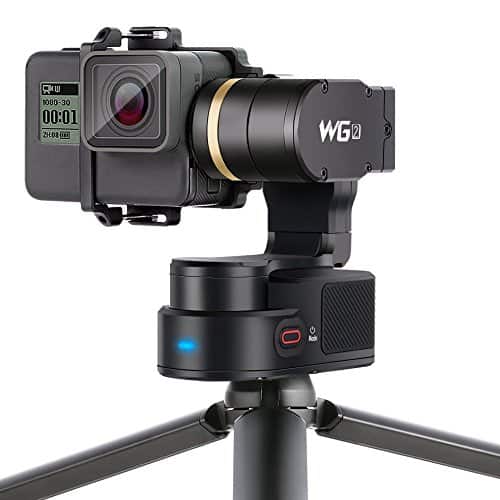
The FeiyuTech WG2 was a wearable action-camera gimbal included in older GoGimbals roundups. An archived product photograph below helps identify the unit, but its presence is not proof that it fits a newer camera or remains supported. If you own a WG2, refer to the original manual and confirm the precise camera dimensions, approved mounts and charging system. If buying used, the battery and availability of matching parts are more relevant than launch-year review scores.
Legacy model: EVO SS wearable gimbal
The EVO SS appeared in earlier coverage as another wearable motorized option. A purchase decision today should not rely on historical price comparisons or guarantees that a modern camera will work. Confirm camera fit, original batteries, compatible accessories and any manufacturer application or firmware requirements. A physically intact gimbal may still be impractical if a proprietary mount is missing or the charging system is unavailable.
Unlike a new model with a current published support list, an older EVO unit may require evidence from the seller and historical documentation to establish compatibility. Avoid broad claims such as “universal GoPro support” unless the particular device documentation explicitly covers the camera in question.
Legacy model: Hohem XG-1
The original Hohem XG-1 belongs to an older generation of wearable action-camera stabilization. It should not be conflated with Hohem’s newer handheld iSteady Pro 4. A comparison between the two requires knowing the exact camera, mounting configuration and desired movement. The iSteady Pro 4 has a manufacturer-published IPX4 splash resistance rating and specified camera limits, but that information cannot be retroactively applied to the XG-1. For current Hohem details, see official Pro 4 specifications.
A passive mount is a different tool
For creators considering a chest-level perspective, a passive harness may be less complicated because it does not require powered axis control. The trade-off is that the recorded viewpoint follows the support’s movement, with fewer opportunities for deliberate framing. Compare the goals and restrictions before adding unnecessary hardware. See our action-camera chest-mount overview.

How to evaluate used wearable equipment
- Identify the exact manufacturer and model; closely related names may be different products.
- Find original camera weight, size and mount restrictions in model-specific documentation.
- Check availability of genuine batteries, chargers, clamps and any relevant firmware.
- Do not infer water protection from footage shot near water or from the waterproof camera itself.
- Consider whether simpler stabilization in the camera already meets the filming goal.
- Never choose a camera accessory that interferes with protective equipment or normal safe movement.
What features matter most?
Stabilization axes and control modes
A manufacturer might advertise two-axis or three-axis correction, following modes and automated movement. Those details are relevant only if they work with the mounted camera and create a movement you actually need. A modern camera’s electronic stabilization may narrow the benefit of carrying additional motors.
Battery age and charging
An older gimbal’s initial runtime claim may be misleading many years later. Inspect the documented charging equipment and current unit condition. A working motor at startup is not enough evidence that a battery will sustain the length of recording you need.
Mount compatibility and environmental limits
Camera clamps, geometry and manufacturer-approved supports define the use case. Do not repurpose a product outside its published limits, particularly where safety gear or weather exposure is involved. The waterproof rating of a mounted camera never applies automatically to the gimbal.
Is a wearable gimbal a good purchase now?
It can be worth keeping or buying a working legacy unit when its original supported camera and mounting accessories are available, it serves a genuinely useful planned viewpoint, and the remaining battery life is adequate. For buyers without a specific reason to use wearable motors, current in-camera stabilization, a conventional camera support or a newer supported handheld gimbal is often easier to evaluate and maintain.
Our action-camera gimbal guide compares current reference points, and three-axis gimbal fundamentals explains why motors control orientation but not all motion. For wet conditions, the water-resistance guide separates splash protection from immersion claims.
Archived retailer references
The following tracked links appeared in the earlier review. They are historical references, not verified current products or prices. GoGimbals may receive affiliate revenue from qualifying purchases; always verify the seller and exact model.
- FeiyuTech wearable gimbal — Amazon ASIN B0744CY6Y3
- Legacy wearable gimbal — Amazon ASIN B01K8W0EFK
- Legacy wearable gimbal — Amazon ASIN B076ZJZ7DV
Editorial method
This guide preserves the legacy models as historical identification references and avoids asserting unsupported current specifications or personally measured test results. The Hohem manufacturer page is cited only for its newer product, not as evidence about the XG-1. Verify discontinued units against the exact original manual and condition of the item offered.
Related reading: For pet harness comfort and framing, consult this related GoGimbals article. For helmet camera safety and equipment approval, consult this related GoGimbals article. For Hohem model differences and protection ratings, consult this related GoGimbals article.